
 858.488.3998
The ROI of Energy Efficiency Retrofits in Southern California
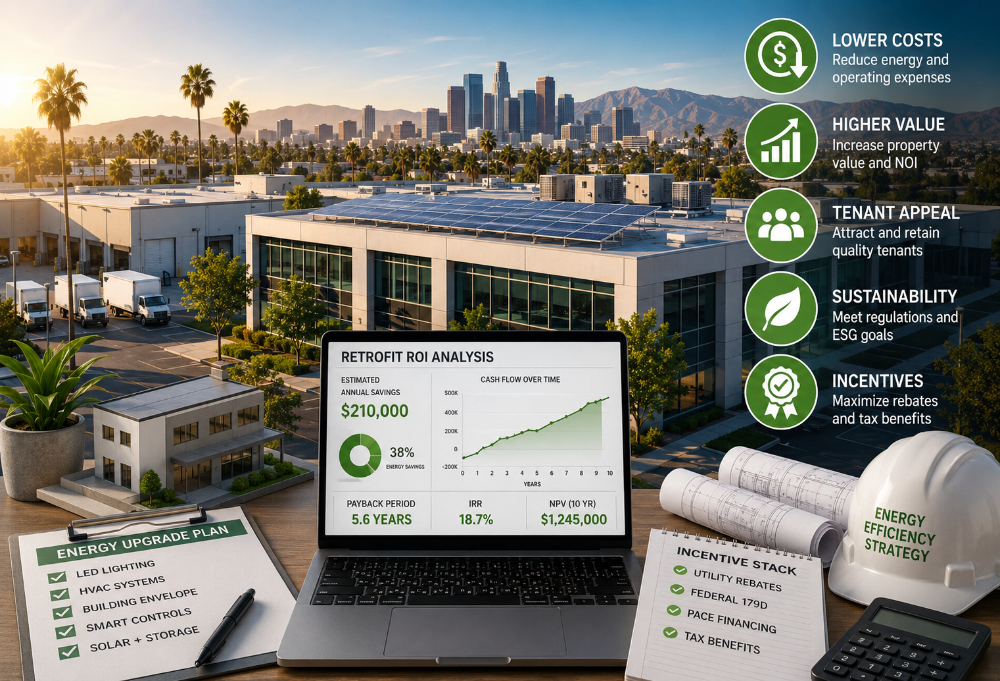
Southern California businesses face some of the highest commercial electricity rates in the nation. With utility costs continuing to climb and state regulations tightening around building performance, the financial case for energy efficiency retrofits has never been stronger. Whether you operate a retail space in Los Angeles, a warehouse in the Inland Empire, or an office complex in San Diego, investing in building energy efficiency improvements is no longer just an environmental gesture. It is a measurable, bankable business strategy.
Understanding the full return on investment requires looking beyond the monthly utility bill. Commercial building retrofits in California touch on tax incentives, utility rebates, property values, tenant retention, and long-term operational savings. When all of these factors are considered together, the numbers tell a compelling story.
What Counts as an Energy Efficiency Retrofit
Before calculating ROI, it helps to understand what falls under the umbrella of energy efficiency retrofits. In the commercial sector, these upgrades typically include HVAC system replacements, LED lighting conversions, building envelope improvements such as insulation and window upgrades, smart building controls and energy management systems, rooftop solar installations paired with battery storage, and upgrades to water heating infrastructure.
Commercial energy upgrades can range from a straightforward lighting swap costing a few thousand dollars to a full mechanical and envelope overhaul running into the millions. The scope depends heavily on the age and condition of the building, current energy consumption, and the owner’s financial goals. In Southern California, older commercial stock from the 1970s and 1980s is especially ripe for intervention, with many buildings still running original HVAC equipment that operates at a fraction of modern efficiency standards.
The True Cost of Doing Nothing
One of the most overlooked aspects of the ROI conversation is the cost of inaction. Commercial buildings in California that fail to meet evolving efficiency benchmarks are increasingly exposed to financial and regulatory risk. The state has expanded its benchmarking and disclosure requirements under programs tied to Title 24 and local reach codes adopted by cities including Los Angeles, San Diego, and Pasadena.
Beyond compliance risk, deferred maintenance and aging systems carry their own price tag. HVAC systems running past their useful life consume significantly more energy per unit of output than modern replacements. A rooftop package unit that was efficient in 1995 may now operate at 60 to 70 percent of its original rated performance, meaning you are paying more for the same or worse comfort. Factor in emergency repair costs, tenant complaints, and the risk of system failures during Southern California’s increasingly intense heat events, and the cost of doing nothing compounds quickly.
Energy prices in California are also structurally higher than the national average and have risen consistently over the past decade. Commercial customers in Southern California Edison and SDG&E territories face tiered demand charges that can make inefficient systems extraordinarily expensive during summer peak periods. Building energy efficiency improvements that reduce demand load can have an outsized impact on these bills, sometimes cutting monthly charges by 20 to 40 percent depending on the building profile.
Incentives, Rebates, and Financing That Improve the Numbers
The ROI of energy efficiency retrofits in Southern California is materially improved by a layered stack of financial incentives that reduce upfront costs and shorten payback periods. Understanding this landscape is essential to building an accurate financial model.
At the utility level, both Southern California Edison and San Diego Gas and Electric offer robust rebate programs for qualifying commercial energy upgrades. These include prescriptive rebates for LED retrofits and HVAC replacements, as well as custom rebate pathways for projects that achieve energy savings beyond standard measures. Rebates can offset 10 to 30 percent of project costs depending on the measure and the utility territory.
At the federal level, the Inflation Reduction Act expanded and extended the 179D commercial building energy efficiency tax deduction. For projects meeting the prevailing wage and apprenticeship requirements, building owners can claim deductions of up to $5 per square foot for qualifying improvements. For a 20,000 square foot office building, that translates to a potential $100,000 federal tax benefit, which dramatically changes the investment calculus.
California also offers the Property Assessed Clean Energy (PACE) financing program for commercial properties. PACE allows building owners to finance commercial building retrofits through a property tax assessment, spreading costs over 5 to 25 years and keeping the project cash-flow positive from day one in many cases. This structure is particularly attractive for owners who want to preserve credit lines or avoid traditional debt.
Green bank financing through the California Infrastructure and Economic Development Bank, combined with on-bill financing options offered by utilities, rounds out a financing ecosystem that makes large-scale projects accessible to mid-market commercial property owners who might otherwise struggle to fund them.
Calculating Payback Periods and Long-Term Returns
The ROI of energy efficiency retrofits varies by project type, building characteristics, and the incentive stack applied. However, generalizations drawn from Southern California projects give a useful baseline for planning purposes.
LED lighting retrofits typically achieve payback periods of 2 to 4 years even without rebates, and often under 18 months when utility incentives are applied. The operating life of commercial LED fixtures extends to 50,000 hours or more, meaning a lighting retrofit completed today will still be producing savings well into the late 2030s.
HVAC replacements carry higher upfront costs but deliver proportionally larger savings in Southern California’s climate. A modern variable refrigerant flow (VRF) system or high-efficiency rooftop unit can reduce HVAC-related energy consumption by 30 to 50 percent compared to aging equipment. Combined with demand charge reductions, payback periods in the 5 to 8 year range are common, with project lifetimes of 15 to 20 years generating strong long-term returns.
Building envelope improvements, including cool roofs, window film, and added insulation, address the thermal load that drives cooling demand. In the Inland Empire and the San Fernando Valley, where summer temperatures regularly exceed 100 degrees Fahrenheit, reducing solar heat gain has a direct and measurable impact on HVAC runtime and energy consumption. These measures often achieve payback periods of 4 to 7 years and improve occupant comfort simultaneously.
Comprehensive projects that stack multiple measures together tend to achieve better economics than single-measure retrofits. When lighting, HVAC, controls, and envelope improvements are modeled and implemented as a coordinated commercial building retrofit, California incentive programs reward the combined energy savings with larger rebates, and the synergies between measures amplify overall performance.
How Retrofits Affect Property Value and Tenant Demand
Energy efficiency improvements do not just reduce operating costs. They create tangible asset value. Commercial real estate research has consistently shown that ENERGY STAR certified and LEED-certified buildings in major California markets command premium rents and higher occupancy rates compared to non-certified peers.
For property owners managing multi-tenant commercial assets, energy efficiency retrofits directly affect net operating income (NOI) through lower common area utility costs, reduced maintenance expenditures, and stronger tenant retention. Institutional tenants, including technology firms, professional services companies, and healthcare operators, increasingly include building sustainability credentials in their site selection criteria. A building that cannot demonstrate energy performance is at a competitive disadvantage in lease negotiations.
Cap rate compression in California commercial real estate means that even modest improvements to NOI translate into meaningful increases in asset value. A retrofit project that saves $50,000 annually in operating costs on a building trading at a 5 percent cap rate adds $1,000,000 in appraised value. That relationship makes building energy efficiency improvements one of the highest-leverage capital allocation decisions available to Southern California commercial property owners.
The Investment Case Is Clear
Energy efficiency retrofits in Southern California represent a rare convergence of operational savings, regulatory compliance, tax benefits, utility incentives, and asset appreciation. Commercial building owners who approach these projects with rigorous financial modeling, strong contractor partnerships, and a clear understanding of the available incentive landscape consistently achieve returns that outperform conventional capital improvements. The question for most Southern California commercial property owners is no longer whether to invest in energy efficiency; it is how to sequence and finance the work to maximize the return.
Need a Lighting Company in California?
Since 2003, we here at Utility Incentive Corp. have been the premier provider of energy efficient electrical services in San Diego and the surrounding areas. We are a privately owned and operated business with 20 years of experience. Our friendly and professional staff work in conjunction with other businesses to provide them with better solutions at little to no cost to property owners.
We focus primarily on relamping and retrofitting T12 lamps and ballasts to “Energy Star” T-8 lamps and “flicker free” ballasts. Our other services include a free initial consultation, energy audit, and utility application. Give us a call today to see why we have installed and replaced over 175,000 fixtures across California!